Saturday, January 11, 2014

Vigilance

Molly and her crate

In the same category as "don't overfeed the dog" was "don't feed her from the table". The spoiled dachshunds I grew up with got more people food than they should have and too often they got it handed to them by people seated at a meal. So of course the family dogs begged at the table and whined and barked when they felt we weren't responding to their needs. 

I really didn't want my dog to do this. Molly never got a table scrap from our hands (which is not to say she never got a table scrap), but she put a few pieces together in her own mind about what we were doing up there and what it meant to her. She was never one to whine or bark or even obviously beg at the table, but she understood the rewards of constant vigilance and of the occasional foray onto the table itself.

We, on the other hand, had been confident enough in our training of the dog that while we knew not to leave things lying around on low surfaces, we thought things on the dining room table were safe. As a failsafe, we always pushed the chairs in under the table, thinking that not even Molly could jump that high. For more than three years, this method worked. 

But that all changed one fateful night when we had a friend over for drinks and snacks before going out to dinner. In the rush of details before leaving, I absent-mindedly left two small bowls on the coffee table with some roasted red pepper dip and some hummus in them.

When we returned from our night out, I saw the small bowls and remarked to myself how very, very clean they were. Of course the dog had gotten on the coffee table and scarfed up the leftovers.

As was so often the case with our understanding of the dog, we underestimated the meaning of Molly's having broken the table top barrier. It seemed like a one-time event for us. We would just make sure not to leave anything on the coffee table again. 

For Molly, it was the opening of a frontier....

For the first three years we had Molly, I worked at home and she slept with us, so we had not used her crate for anything but transporting her when we travelled by car. The events arising in the aftermath of the evening we had our friend over were in some measure the reason why we started to crate her.

Not long after the evening out with our friend, I came home one day at lunch time to give Molly her walk. There was evidence everywhere in the form of little pools of dog barf on the carpet that Molly had indeed gotten onto the dining room table and had eaten about a half a pound of butter.


I came home a few days later at lunch time and found little patches of chewed clean hairless carpet on the spots where Molly had barfed. Clearly the clean up had not gotten all the butter. Just as clearly the dog could not be trusted on her own. So we started putting her in her crate when we weren't at home.

When we were at home, and eating at the table or preparing food in the kitchen, Molly remained vigilant for the opportunities gravity brought her as crumbs fell like rain from the dining room table, or chopped vegetables and other goodies dropped from the kitchen counter.  

We never left anything on the dining room table again. But that didn't mean the dog gave up trying for another sweet bonanza she knew she'd scored at least twice before. Once in a while, I'd come out of one of the bedrooms in our condo when the dog and I were home and see the cloth on the dining room table rucked up at one end, the kind of thing you'd see after a dog had launched itself to the floor from the table top.

Molly keeps a vigilant eye on the lower corner cabinet where we stored her biscuits.

When Molly wasn't obsessing about food, she was happy to play, which you can read about here.


Saturday, January 4, 2014

Grooming

I knew from my experience as a kid with our dachshunds that dogs need their nails trimmed and their teeth brushed. I also learned from that experience that, if you don't start early, you'll never get the dog to go along with your plans.

I started trimming Molly's nails as soon as we got her. She hated it right away. But she knew from the very first time that if she suffered through it she would get a treat. Every time I grabbed her, flipped her over and put her four paws in the air, she would resign herself to her fate and relax on my lap. Once she sensed I was done, she reanimated, flipped over practically in mid-air, leapt to the floor and made a bee-line for the cupboard where we kept the dog biscuits.

Brushing Molly's teeth was Bruce's job and he performed this duty every day of the dog's life - even the morning we put her down. Molly would also be flipped on her back for this procedure. Then Bruce would move a small brush loaded with chicken-flavoured dog toothpaste around in Molly's mouth. The trick was to get the dog's teeth brushed before she'd eaten all the toothpaste. 


Bruce was never certain that this accomplished anything, but, in all of Molly's long life, she lost only one tooth (a lower front incisor just fell out one day) and she never had any teeth extracted.

Then of course there were baths. Dogs in theory don't need baths. For example, the beautiful wolf in the shot below is quite dirty, but has her dignity and perhaps even her health intact.

Photo Credit: Mukul Soman, Your Shot, National Geographic

The received wisdom when I was a kid was that bathing disrupted the natural balance of a dog's skin. However, dogs - especially our dog, who sat on our furniture and slept in our bed - need a bath every once in a while. And dog cleaning technology has progressed by leaps and bounds. Products on the market today are so mild you can use them every day if you like - and if your dog likes.  

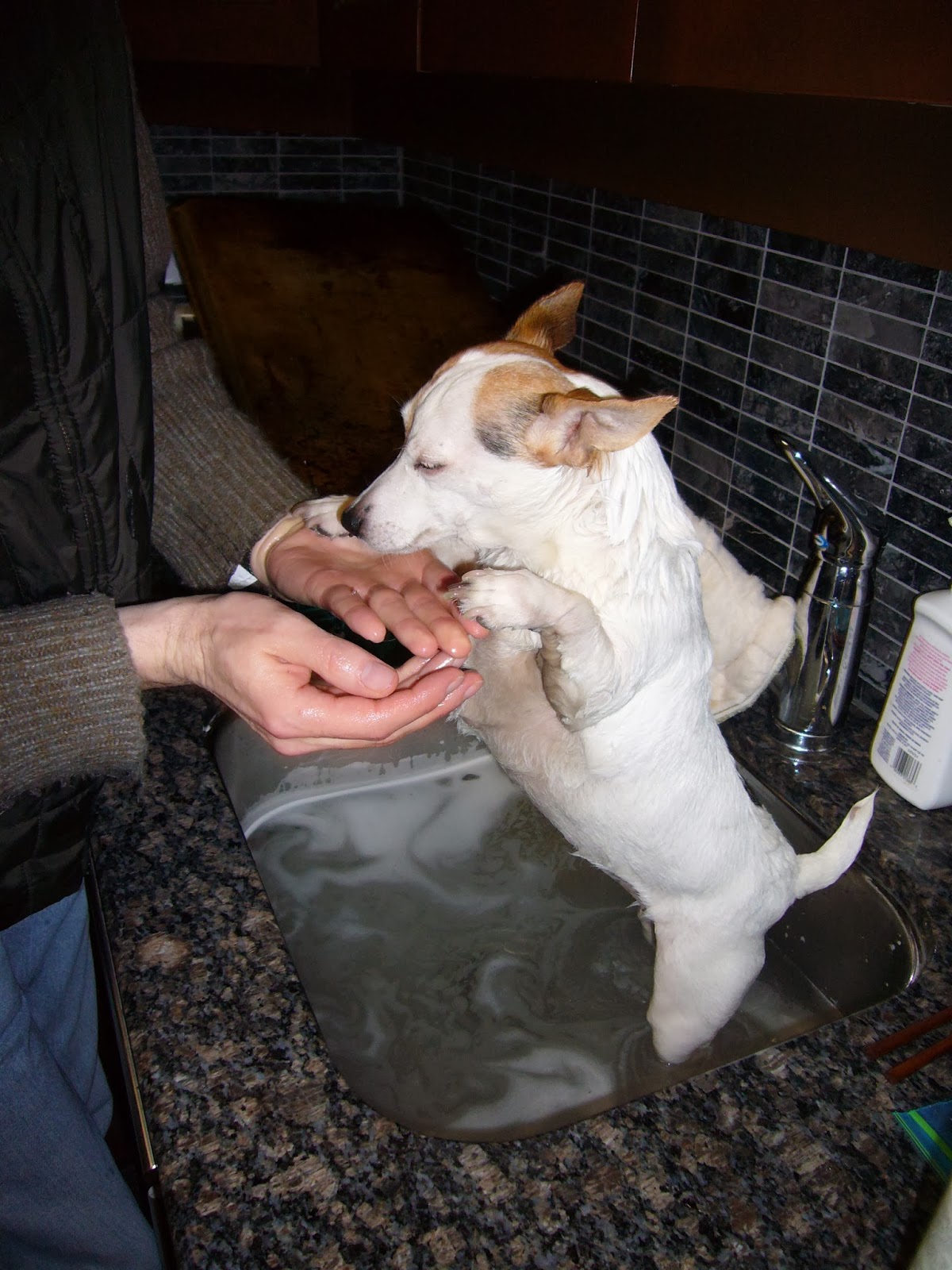
Molly did not like baths, even when there was a treat waiting for her. But Bruce - who most often was the one to give the dog her bath - noted that as she aged, Molly came to appreciate the hot water and wouldn't fight like a tiger to get out.

Molly fighting to get out of the tub.


Molly fighting to get out of the sink.
The only other grooming issue with the dog was her hair. Smooth coat JRTs don't need to have their coat cut or plucked. But, all owners of smooth-coated JRTs need a powerful vacuum cleaner. I used to say that Molly shed her own weight in dog hair once every two weeks. As far as I'm concerned that was the honest truth. For sixteen years our home, our floors, our furniture, our towels, our clothes and our guests were covered in a diaphanous coat of dog hair. 

I don't believe for an instant that Molly appreciated any of our efforts to keep her clean; I'm even more certain that she disagreed with other policies in place to keep her healthy, as you can read here.


Monday, July 1, 2013

Mishaps Part Three: Barfing

Molly in the Homewood Parkette
When we got Molly I made a number of solemn vows regarding the health and welfare of the dog, the first among them being that we would not feed her people food. The second was that we would not overfeed her.

While we were good at keeping the second vow, we had a bit of trouble getting others to honour it. One of the reasons we eventually stopped taking Molly to crowded dog parks was that we could not prevent other dog owners from giving her dog treats, even when I explained that we didn't want her to have any.

I had good reason to do this, and not just to control the dog's caloric intake. One time, when she was still just a puppy, I had her in the sports field at Jarvis Collegiate with maybe eight other dogs and their owners. A couple of the owners asked if they could give her a treat, and I said "sure" because I didn't know any better at the time. Minutes after the treats went down, they came back up again. I surmised that the combination of unknown food and the excitement of being out of doors made the dog barf. So I explained to everyone who asked after that, that "no" they could not give my dog a treat because it would make her barf. But, lots of people didn't bother to ask.

I'm not quite sure why people like to overfeed dogs, but they do. My family overfed the dachshunds we had when I was growing up. One habitue of a small parkette on Homewood Avenue - who had a severely overweight black Scots terrier - called me an "ogre" because I wouldn't let him give Molly a treat.

His dog died when it was eight years old.

It wasn't just because Molly's barfing provided a handy pretext to keep people from giving her treats; we long thought Molly had a very sensitive stomach. For example, until we learned to not feed her before trips, she always barfed when we travelled by car, something about the effects of de-acceleration on her little body (barfing occurred when we turned off the highway and had to reduce our speed). For maybe the first two years that we had her, we were woken almost every morning to the sound of the dog working her way up the vomit curve. Bruce or I would grab her and run for the bathroom so she could vomit on tile, or in the sink, and not in our bed or on the carpet.  

It finally dawned on us, after months and months and months of this, that it might be the dog's food that was the root cause. When we got her from the breeder, we fed her Eukanuba puppy formula, and, because she seemed to like that OK, after she was six months old, we switched her to Eukanuba adult formula, which she also liked well enough. But Eukanuba is high in fat. We switched her to a low-fat dog food - actually designed for dogs on a diet - and she never barfed in the morning again. Which is not to say she never barfed again.

There was the short experiment in feeding her home-made food in an attempt to help her repel her infestation of demodex mange. The naturopath vet had given me a recipe for what she called "healthy power", which was a mix of brewer's yeast and wheat germ and a bunch of other stuff I can no longer recall. I kept it in the fridge and added a teaspoon to the dog's food every meal. I was putting the container of healthy powder away one day when I accidentally spilled a small quantity - more than a teaspoon less than a tablespoon - on the floor. The dog was on it instantly and very helpfully cleaned it right up. I was unconcerned. It was healthy powder after all. 

Molly barfed for the next half-day. 

Before you get the impression that we never did anything other than imperil Molly's life, I'd like to add that, most of the time, we took good care of her, as you can read here.

Karen


Wednesday, June 26, 2013

Mishaps Part Two: The Worst Moment In My Adult Life

This is a very difficult post for me. I'll start with the story the vet told me in his effort to make me feel better.

A father and son were playing with their boxer. The dad was gently lobbing a softball at his son, who hit it with a baseball bat to send it flying. The boxer was having the time of his life fetching and retrieving the baseball. You can almost predict what happened: in one awful moment, the ball, bat and the dog's head all came together. The dog's jaw was broken, the father and son just devastated. The vet assured me of two things: first, the dog's jaw was repaired and everything was fine and second, what I'd done to Molly was nothing compared to that accident.

So this is what I did to Molly.

Once we'd discovered that Molly loved chasing sticks, my mornings went like this: I would get out of bed around 6 a.m. and, while Molly and Bruce continued to snooze, I'd get dressed. Then Molly and I would go over to the sports field behind Jarvis Collegiate right next door. Many large trees lined the property and there were always sticks around. I'd find a stick and throw it for Molly for anywhere between a half an hour and an hour, until the dog seemed good and pooped. Then we'd go inside, wake Bruce up and eat our respective breakfasts.

One morning I found a great big long stick - twice as long as Molly. Molly loved chasing big sticks, and looked supremely comical carrying one - carefully balanced - in her mouth.

This stick was very long, so I was taking care to avoid the dog who was prancing around my feet. But, I wasn't careful enough. Halfway through one big underhand swing I felt the stick connect with something and I said a quick prayer that it was not the dog as I looked down.

I had hit the dog. Molly was curled in a fetal position on the ground, not moving. In shock, panicking and full of pain and sorrow, I dropped the stick, picked up the dog and ran back home. I couldn't bring myself to look; it was everything I could do to keep myself composed as I made my way back to our apartment.

Instead of me dealing with how the dog looked, I forced Bruce to. I plunked down on his side of the bed and said, "look at Molly and please tell me I haven't blinded our dog."

Thrilled to have been woken in such a manner, Bruce still dutifully did as asked. His exclamation of dismay when he saw Molly's face destroyed my last shred of composure and I burst into tears. 

There really didn't seem to be much point in spending time explaining to Bruce what happened, though I did try, and it gave me the time I needed to gather myself enough to call the vet and say I needed to bring my dog in right away.

The vet determined that Molly's skull had done just the job it had been designed to do and fully protected her eye from the force of the blow. They assured me no serious damage had been done and prescribed, as a precaution, some antibiotic drops for her eye. And they told me the story, related above, that I found truly not comforting at all.

I took two pictures of Molly to record this sad series of events. One the day of as a reminder to not play with inappropriately large sticks. One a few days later to show how quickly she had healed.

I'll start with the photo of how well she healed, which also features her new favourite toy:


And here's the record of the worst moment in my adult life.


I'm glad to say we never again did anything so distressing to the dog, except for, of course, the day we put her down.

We did do this, though.

Thanks for reading!

Karen

Saturday, June 15, 2013

Amusement

Before I go into too much more detail about how we inadvertently and hugely regretfully every once in a while did something awful to the dog, I need to explain a bit more about what a challenge it was to keep the dog amused, exercised and happy.

We knew instinctively that if not exercised a lot every day Molly would blow all her unspent energy on something evil. It was our quest and purpose in life to make sure she was not bored.


What made this difficult was Molly was a novelty seeker. There was nothing she loved more than a new toy and nothing failed to obtain her interest more than that same toy when, well, it wasn't the newest thing anymore.


Recalling that we got her late in September and that she was a small dog, the first six months of her life were spent of necessity for the most part indoors.  


We had a long hallway in our condo, and we launched balls, kongs, sock toys and other diversions endlessly down that hall so the dog could tear after it and bring it back to throw again. This was good exercise and it kept her happy. But our dismay was real on the day that inevitably came when we would launch the toy and she would stand stock still looking at us with an "is that all you've got?" look on her face.

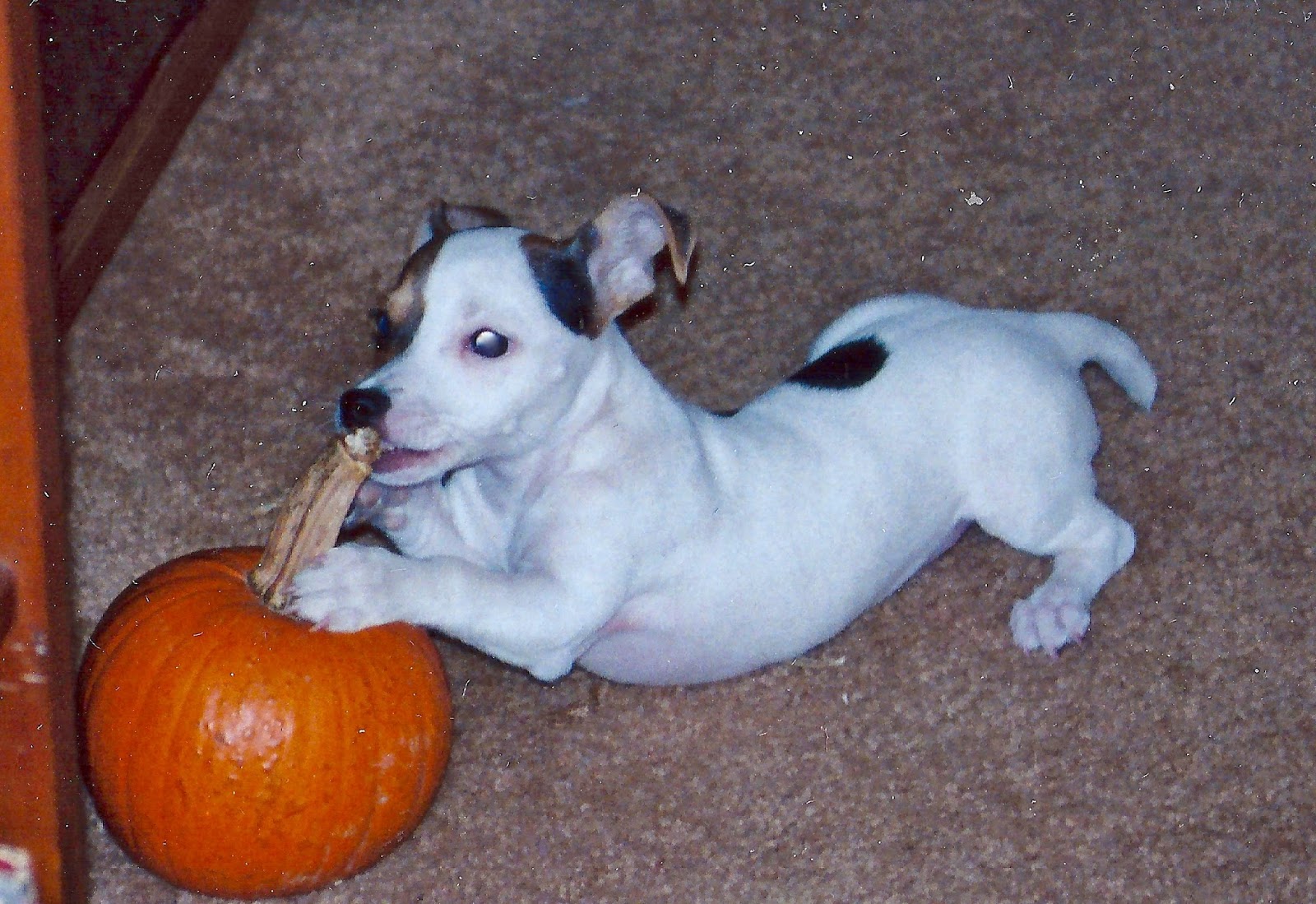
And, while she had a thing for pumpkins, we didn't see this as a viable toy of choice.


So it was with some relief that we discovered, when the spring came and we could take her outside again, that Molly loved sticks in all their endless variety so that it never seemed to her as though we threw the same one twice.


This was the perfect solution. And absolutely nothing could go wrong.

Until it did. 

Click here to read more.

Karen


Saturday, June 8, 2013

Mishaps Part One: Mange

Molly's breeder explained the life expectancy of a Jack Russell this way:

"If they make it past their first year, they usually last fifteen or more." 

What she meant was that Russells, in the salad days of their impetuous youth, can and do end their lives in sad and silly ways. Like the dog she bred that launched itself out of the window of a moving car to chase a squirrel. Or the one that disappeared down a deep hole in pursuit of something and never came out again. 

So forewarned, we tried as hard as we could to protect Molly from her number one risk factor: herself. 

That left the number two risk factor: us. 

Before Molly had completed her first year, either directly or indirectly through the actions of her two protectors, Molly was infested with mange, poisoned and clobbered with a stick. None of these were intentional of course, but still.

The mange infestation happened like this.

Russells have a very robust constitution. From the time she was eight weeks old, Molly felt solid, strong, sturdy. But, she was a regular little dog in that she needed her various immunizations against dread diseases. After she'd had her second round of shots for kennel cough et cetera, I noticed that a small patch on her left side was losing hair and looked oddly dirty.

It was demodex mange, a non-contageous critter that always lives on dogs, and takes its opportunities as they arise when the dog's immune system is weakened - as it would be say, after a series of shots. 


Dispositionally inclined to be suspicious of western medicine for both dogs and humans, I eschewed for a long time the  truly shocking-sounding treatments proposed by Molly's usual veterinarian. 

I took instead the advice of a naturopath vet I went to go see in East York, and made with my own hands out of ground lamb and other goodies putatively immune-system-boosting food for Molly.

Here's a picture of her licking the spoon.


The alternative approach did not work all that well. Molly grew weary of the home-made food in less than a month and the supplemental "healthy powder" I added to it had sub-optimal effects (more about which later). Plus, the mange didn't budge.

After another negotiation with her vet - whose first offer had been to dip Molly in a vat of toxins for the going rate of about $600 - we experimented with a cheap ($18), long-term (6 weeks) therapy of orally administered micro-doses (3 ml at a time) of a treatment normally used on sheep to treat demodex. It took every last drop of the medicine and every day of the six weeks, but the course of treatment worked. The mange on her side went away. She did carry to her dying day, however, a small patch of the same stuff on the end of her docked tail.

Keeping Molly healthy was not as challenging as keeping her entertained, more about which in the next post. 


Sunday, June 2, 2013

Competition

Early on in her life, Molly got very used to lots of attention.

When she was still too small to walk on a leash, I'd carry her around in the crook of my arm. Without fail, upon someone sighting her, there would be this high-pitched "Ooooh, look at the cute little dog!" Then the people making that noise would approach and ask if they could pet her.

Molly came to recognize that sound, and, upon hearing it, would set herself up for some sweet, sweet cuddly interaction with an endless series of admirers. 

However, it is an important life lesson for all of us that we are not the apple of everyone's eye.

Shortly after we got Molly, my mother, who had just lost the last of the three dachshunds she'd had for many years, got another puppy, whom she called Schatzi.  

Schatzi was a miniature dachshund with the then-rare (but now insanely common) dapple coat. She was born the day, September 30, we picked Molly up from the breeders. 

Mom would bring Schatzi with her when she and my sister, travelling in from Trenton, would drop by for lunch before attending a matinee at a downtown Toronto theatre. 

While my mother and sister were out at the show, if the weather was nice, Bruce and I would take the dogs for a walk and run some errands. We'd take turns waiting outside with the dogs while the other went into a shop.

On one cool, pleasant summer's day many years ago, it was my turn to stand outside. Molly and Schatzi were well-behaved on their leashes on the sidewalk next to me, sitting patiently, waiting for things to get interesting again.

Then there was that "ooooh" sound. I looked up and saw a young man smiling at me. "May I say hello to your dog?" he asked. "Sure," I said, assuming he meant Molly. 

He bent right over and picked Schatzi up. He squeezed her softly and kissed her on the side of her head. He explained he was visiting from San Francisco, that he had a dog like Schatzi back at home, hadn't seen her in a couple of weeks and missed her terribly. "She's just like her," he said, and I could feel his fondness for both the dog he missed and the one he held in his hands. 

He gave Schatzi one more hug, thanked me, and put her gently back down on the sidewalk. He acted as if he hadn't even seen Molly.

Molly was every inch the affronted prom queen whose date has just asked to dance with the least popular girl at school. It's hard to think that you'd even need to teach a dog about humility, but Molly got a lesson that day.


Molly and Schatzi Christmas 1995: Puppies, Rivals

Molly's hard lesson in not always being the centre of attention was not the only peril she faced. You can read more about that here.